Last year, I had the extraordinary opportunity to meet US author and podcaster Derrick Jensen in the quiet hills of rural West Cork. Derrick’s books—critical, deeply personal, and unflinchingly honest—resonated with me like few others. Here was someone who truly grasped the depth of the ecological emergency, someone whose words had galvanised activists and eco-minded people for years. His work shaped my own thinking about the urgent need for ecoliteracy long before I began my doctorate, long before I understood that education itself needed a radical reorientation.
Meeting Derrick in person was a gift (Thank you, Bridget Ann Ryan!). As we walked among megalithic stones in a valley encircled by low hills, I shared that I was creating an online course, Evening Thoughts: Dark Skies, Deep Time. I thanked him for his brilliant interviews with Thomas Berry in his book of interviews – Listening to the Land. Thomas, a profound cosmo-ecological thinker and cultural historian, spent decades studying the world’s wisdom traditions and Indigenous cultures to uncover the “ecological imperative” of living well on Earth. His insights—now more vital than ever—are captured in essays like The New Story and books such as The Great Work and Evening Thoughts (the inspiration for my course’s name), not to mention his contribution to the timeless, inclusive and intergenerational vision of the Earth Charter.
Berry’s vision was nothing short of a revolutionary call for a life-sustaining era: a call to reimagine education, creative practice, law, and even cosmology through an ecologically wiser, more just and compassionate lens. His work inspired the Thomas Berry Foundation and the new Yale University Forum on Religion and Yale Centre for Environmental Justice website, The Living Earth Community—an amazingly comprehensive and inspiring resource launched last year. I highly recommend it for artists, educators, scholars, legal minds and policymakers in all fields (I so wish I had this 30 years ago when I started out)
Derrick recounted his second and final meeting with Thomas, sensing that Thomas feared his work might be forgotten. I find that hard to believe, though I do despair at how rarely his name appears in education, creative practice, or eco-art discourse—despite his influence on figures like art critic Suzi Gablik, whose seminal 1990s works (The Ecological Imperative in Art essay and The Re-Enchantment of Art) were energised by Berry’s ideas. Even in the growing movements for Rights of Nature, ecocide law, and ecojurisprudence, his legacy feels underacknowledged, although it’s heartening how Earth Charter International honours his legacy.
Standing among those ancient stones, surrounded by hills in that quiet, unpopulated valley in West Cork, I was struck by the parallels to small Drummin Bog—encircled by woodland in a secluded corner of South Carlow. Both places felt like perfect gathering spots to wonder at the dark skies, to learn with awe and in community. No doubt, such sites were used for exactly that purpose thousands of years ago.
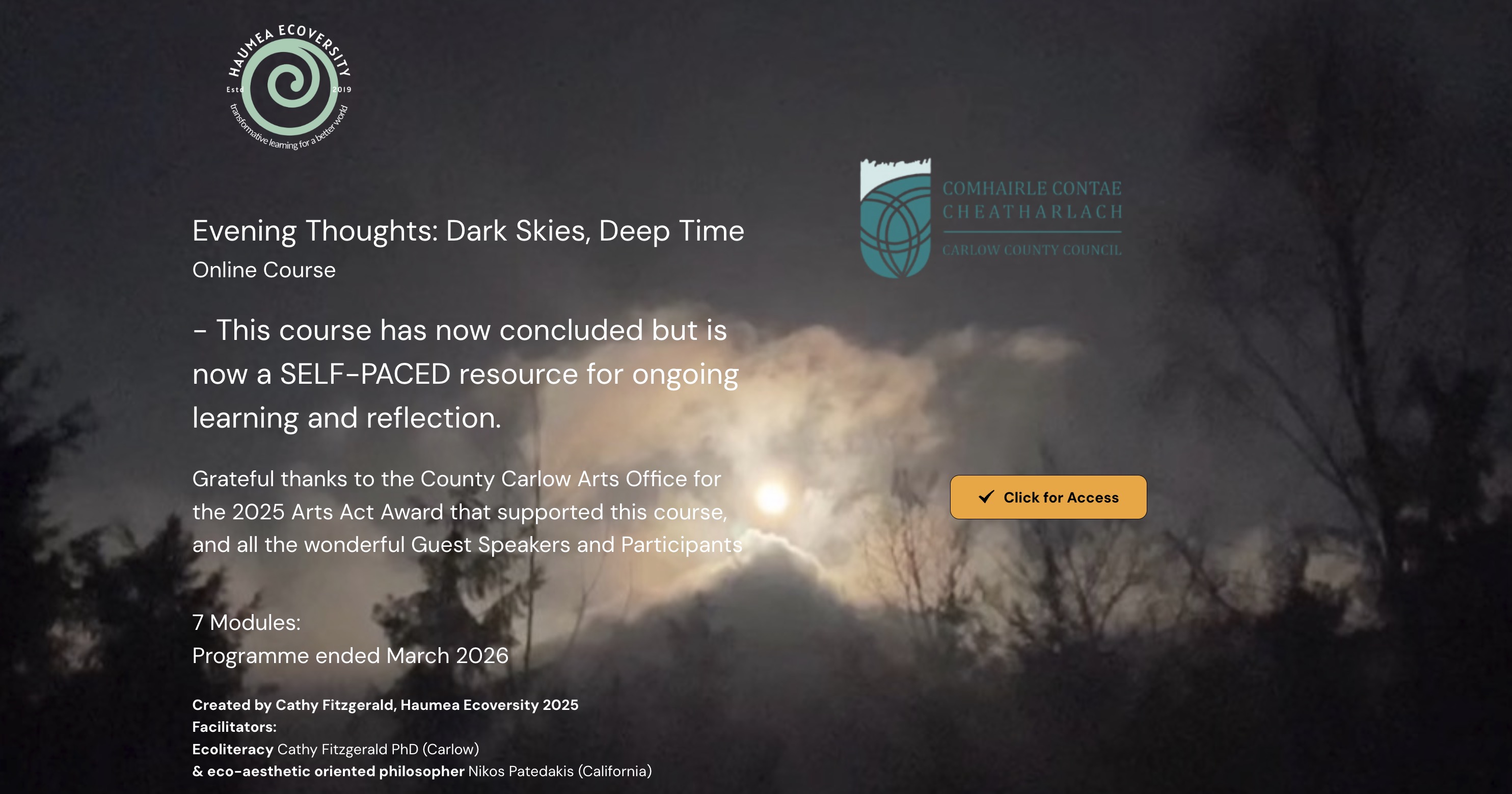
So, I shared my thoughts about Evening Thoughts: Dark Skies, Deep Time—now a free, self-paced resource—with Derrick, and now with you. It’s my small contribution to increasing ecoliteracy and nature connection, for ourselves and others.
Thank you, Derrick. Thank you, Thomas. And thank you to everyone who contributed to this special Evening Thoughts course, now a cosmic-ecological learning resource.
P.S. From reading Derrick’s books, I know we share a favourite habit: we’re both lucky to live among forest communities, and our favourite thing is to look up through the trees at night to see the stars. I like to think Thomas did the same.
PPS: I also think Thomas would have loved the emergent global Ecoversity Alliance begun in 2015 – now 400 of us in 400 countries are bringing forward a more holistic vision of learning with places and people, and the stars.

