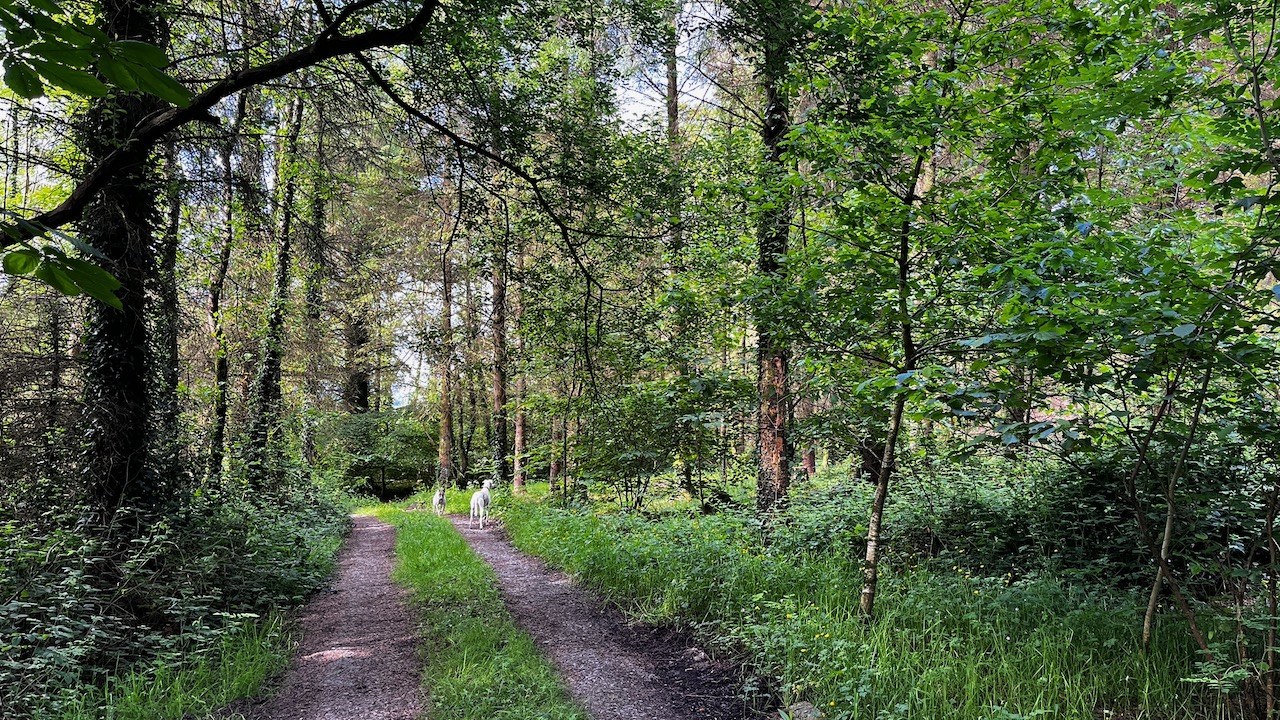
Last year I was delighted to be invited to be part of a newly developing network arising in Scotland called the New Leaves Network (NLN)
‘By exploring a series of long-durational, living artworks – ranging between 50 and 400 years – the New Leaves Network (NLN) brings together national and international forestry and cultural researchers, practitioners and stakeholders to understand the multiple roles that such interdisciplinary projects can play in shaping future visions and actions.
NLN will produce resources addressing adaptive governance, biosecurity and resilience, and a toolkit that supports co-creative and innovative partnerships for sustainable futures.
At the first meeting of the New Leaves Network, hosted in Scotland, March 2024, which sadly I couldn’t attend, I was surprised to see in the follow-up notes, mention of the Hollywood Forest Story as contributing to key questions with other creative-forests projects that I hold in esteem (years ago at art college I was taught by a German Joseph Beuys scholar, Prof Maria Lerm Hayes, so to see mention of my work alongside his and others I have admired was so unexpected).
The first New Leaves Network meeting was convened by Scotland-based Chris Fremantle (arts producer and lecturer at Gray’s School of Art, also very active on the professional international EcoArt Network), and Dee Heddon (Professor of Theatre Studies at the University of Glasgow).
Update: there is a growing online ‘padlet’ project network sharing New Leaves members at https://rgu.padlet.org/cfremantle/new-leaves-network-27i6tbw8ls0e11ln
‘Background to the New Leaves Network: an interdisciplinary exploration of living art-forest projects (newLEAF)
At this first meeting, Dee Heddon shared the background to the creation of this New Leaves Network:
‘With thanks to the Royal Society of Edinburgh for its seed funding, and Forest Research for its partnership with the project,’ Dee explained that ‘the idea for the network had emerged from some of the arts-led work in newLEAF, a science-led Future of UK Treescapes project that is focusing on uncertainty and adaptation in trees and forestry.‘ (I had been invited to take part virtually in one Treescape event last year where I spoke on the urgent need to think beyond the ‘right tree in the right place’ to implement wiser Close-to-Nature forestry practices – I was compelled to talk about this given the talk coincided shortly after the serious harm monoculture tree plantations caused in Aotearoa New Zealand, especially the catastrophic Storm Gabrielle extreme weather event, Feb. 2023).
More specifically, Dee explained ‘that the idea for the New Leaves network had emerged from newLEAF’s interdisciplinary exploration of a selection of durational/living forest-art projects. The interdisciplinary exploration of Case Studies such as Katie Paterson’s Future Library, Joseph Beuys’s 7000 Oaks, Caroline Wendling’s White Wood and Cathy Fitzgerald’s Hollywood Forest Story had generated three key questions: (I’ve added some reflections in brackets below)
- How do we manage the governance of durational/ living forest-art projects, especially in a context of insecure short-term funding and the precarity of both art and artists within this context? (Here I think, the Irish government’s Arts & Heritage Dept, pioneering efforts to trial a Basic Income for Artists over the last two years (a report has just been released), is essential to help formulate secure livelihoods for creatives who work long-term with place and communities, whether creatives work in forests, peatlands, coastal or urban settings. The UK New Economic Forum – nNEF – highlighted a need for new models to support creatives working in the sustainability area years ago. I know that I have only been able to do the work I do on the ongoing Hollywood Forest Story, as I have the good fortune to be living in my home within Hollywood Forest. I have also been fortunate that my PhD doctoral supervisor, Dr Paul O’Brien wrote a book on Basic Income 7 years ago – Pennies from Heaven, which highlight the need to support creatives over the longterm).
- What are the forestry issues in such projects? For example, with Beuys’s 7000 Oaks, and Caroline Wendling’s White Wood, what are the silviculture and biosecurity implications of collecting acorns in Kassel/Germany and planting them in other parts of the world? (Yes, this is problematic for sure. In addition, the forestry sector must look urgently to integrated approaches such as Close-to-Nature forestry management. There are decades of best practice advanced by more ecologically-aware foresters from across the world with the international ProSilva.org organisation (in the UK, The Continuous Cover Foresty Group CCFG promotes ProSilva forestry principles).
We must also not overlook Indigenous forestry management, like that of the Menominee nation in the US, whose more holistic worldviews and intergenerational cultural practices has enabled them to fluently practice ecological forestry over thousands of years for collective, planetary and intergenerational wellbeing. The US ecological thinker and farmer Wendell Berry interviewed the Menominee in the 90s, which I read when I first started with Crann (an Irish native tree species advocacy NGO) in the 90s, in an article that has long inspired my work ‘A Good Forest Economy’ – Wendell’s reflections on Indigenous forestry wisdom was at the time reprinted in the Scottish magazine – The Radical Rowan). - How might questions of human diversity intersect with (or problematise) questions of diversity in conservation and environmentalism, and how might we nurture human diversity through durational/ living forest-art projects? (This is a vital reflection too, to involve diverse forest cultural perspectives and to think about who is invited to rethink our relations with forests and who are not included. Following on from above, this week I’ve been excited to hear more developments about new global networks of Indigenous foresters forming – a recent example is the Maori-led international network led by Ngā Pou a Tāne (the National Māori Forestry Association of Aotearoa New Zealand that formed last year to convene global online seminars with ecologically-aware foresters and with Irish Pro Silva foresters too). In the last week Ramona Radford, forester for Ngā Pou a Tāne, shared how they are connecting with Menemomee foresters, Irish and other ecological foresters from across the world).
Looking toward Indigenous forestry wisdom is vital when scientists have confirmed that the remaining 85% of the most biodiverse regions left on Earth are tended by Indigenous peoples. Such perspectives can complement modern forestry science and we can learn from Indigeous cultures that we need a fundamentally different worldview and new stories that emphasise our interdependence depends on others’ species and habitats thriving. This underlines the necessity that the dominant modern culture needs ‘a New Story’, a new ‘Universe Story’ as the profound ecological thinker Thomas Berry, highlighted some decades ago. Berry’s ideas to advance an ecological worldview have been supported by many who worked to increase awareness of the peoples’ and UNESCO-endorsed Earth Charter that was deeply inspired by Berry’s ideas.) - A collective deepening and broadening of this exploration, in partnership with (and moving beyond) the remit of the newLEAF project, was the hope for the New Leaves Network. What (and who) has been missed in the process so far? What might we learn from each other, and how might we offer each other support/ nurture more work in this intersection?’ (Going forward, I will be excited to contribute more connections to this network and share news of this incredible resource to others too).
There is more. Another researcher for the New Leaves project, Dr Rachel Clive, reached out to me some months ago to do a virtual interview. Having had an very busy time since last Summer, I was delighted to share what I could with Rachel, but I had perhaps not taken in what the interview was for.
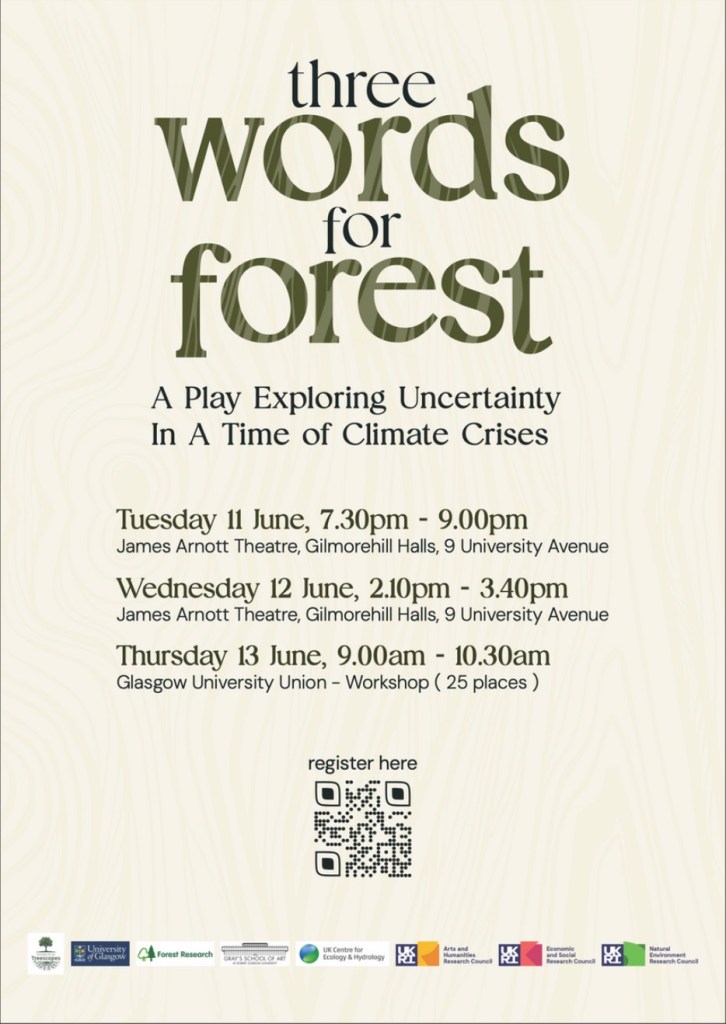
More surprises. Some 30 extracts from some of the interviews that Rachel has been undertaking are to be performed live next week in a new verbatim theatre work in Glasgow (there will be three performances) as part of the 2024 Treescapes conference. Apparently, an Australian actor is going to ‘play me’ and read some of my reflections among others. Glory be! I’m sad due to other commitments I can’t attend, but if you are in Glasgow or nearby, and interested in the potential for creative practices to engage people in forest habitats and the need to re-envision more integrated forestry management for these urgent times, here are the booking details on EventBrite – I have copied the information below:
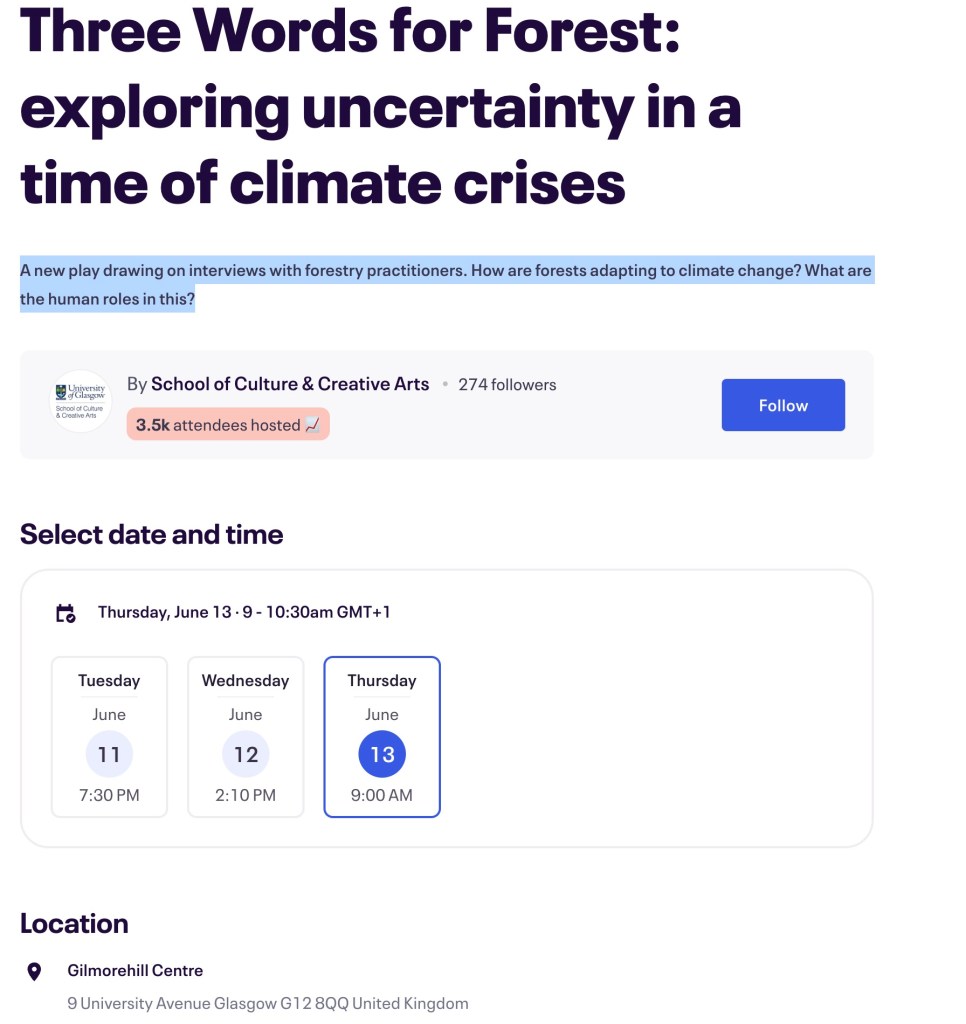
About this event
- 1 hour 30 minutes
Three Words for Forest draws on 30 interviews with forest practitioners, researchers and policy-makers from across sectors and geographies to explore the challenges, complexities, hopes and fears of working with trees and forests in a time of climate crisis.
Humans need trees and forests. But do trees and forests need us to survive? Or are we simply interfering with their natural processes? How are trees and forests adapting to climate change? How do human actions and decisions impact on these processes? How do we understand, live and work with these complexities and uncertainties?
This verbatim play brings together a professional creative team of actors, artists and musicians, who open up new ways of listening to voices of experience. Presented as part of the final Future of UK Treescapes conference, Three Words for Forest offers a one-off opportunity to come together differently around forestry questions that affect us all.
Performances are free but there is limited availability. If you book a place but find you are unable to come, please cancel your booking so that someone else can use your place.
Performances will take place in the James Arnott Theatre, Gilmorehill Halls, 9 University Avenue (see map)
Tue 11 June, 7.30pm -9pm
Wed 12 June, 2.10pm -3.40pm
There is also a workshop on Thu 13 June, 9-10.30am, for those who attended either performance. This workshop offers the opportunity to reflect collectively on some of the questions raised by and explored in Three Words for Forest. Places for this workshop are limited to 25. The workshop will be held in the Glasgow University Union.
Three Words for Forest is led by Professor Dee Heddon and Dr Rachel Clive and is a creative research output of the interdisciplinary project, newLEAF – UK Treescapes. It is a research collaboration between the University of Glasgow, Forest Research, The UK Centre for Ecology & Hydrology, and Gray’s School of Art, and is funded by UK Research and Innovation.
The Future Treescapes 24 (zohobackstage.eu) conference, held in Glasgow from 11-13 June, is free to attend. If you are interested, just register at the link.
Acknowledgements:
My deep thanks to Chris Freemantle, Rachel Clive and Deborah Heddon for the invitation to join this extraordinary New Leaves Network. I’m also grateful for associations I’ve built over the years with creatives and cultural researchers in Scotland: from the 2014 PLACE International Conference – Invisible Scotland with Professor Mary Modeen and Dr Iain Biggs, to The Hollywood Forest Story being listed in Creative Carbon Scotland’s Library of Creative Sustainability, to the Scottish-Irish The Rural-Reimagined programme and also to Scottish-based artist Phoebe Cope who has translated the Earth Charter into Irish gaelic.
I’m thrilled to be part of these New Leaves Network dialogues, meetings, and events. Connecting with other creatives who have developed durational practices to reimagine life-affirming relations with forest habitats is inspiring. Coming together and sharing will generate more impact to radically rethink how we can live well with forest habitats, one of Earth’s vital ecosystems on which all life depends and I know this will be a great resource for many others creatives drawn to part of regenerative cultural practices.

